
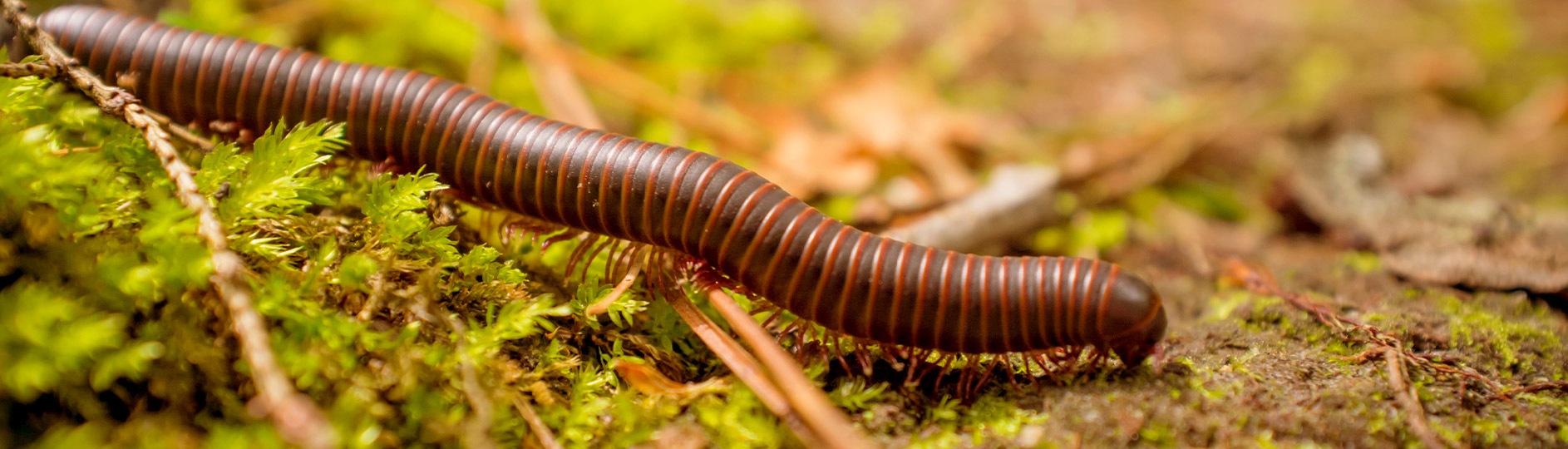
MILLIPEDE CONTROL
Millipedes don’t want to be in your house any more than you want them there. They live outdoors in damp soil and leaf litter, feeding on decaying plant material, and they only come inside when something pushes them out: heavy rain, a dry spell, or a cold snap. Once in, they can’t survive the dry air for long, which is why most of the ones you find are already dead or on their way.
MILLIPEDE CONTROL,
DONE THE NINEFOLD WAY
- We treat the source, not the symptom: Sweeping up the ones indoors takes five minutes. Keeping the next wave out means treating the population living in the soil and ground cover around your house.
- We find what’s keeping it wet: Overwatered beds, poor drainage, and thick mulch against the foundation are what build their numbers. Your technician points out what’s holding the moisture.
- We seal the way in: Millipedes come in low, through door thresholds, foundation cracks, and utility openings. Those get treated and addressed so the next rain doesn’t send a hundred more.
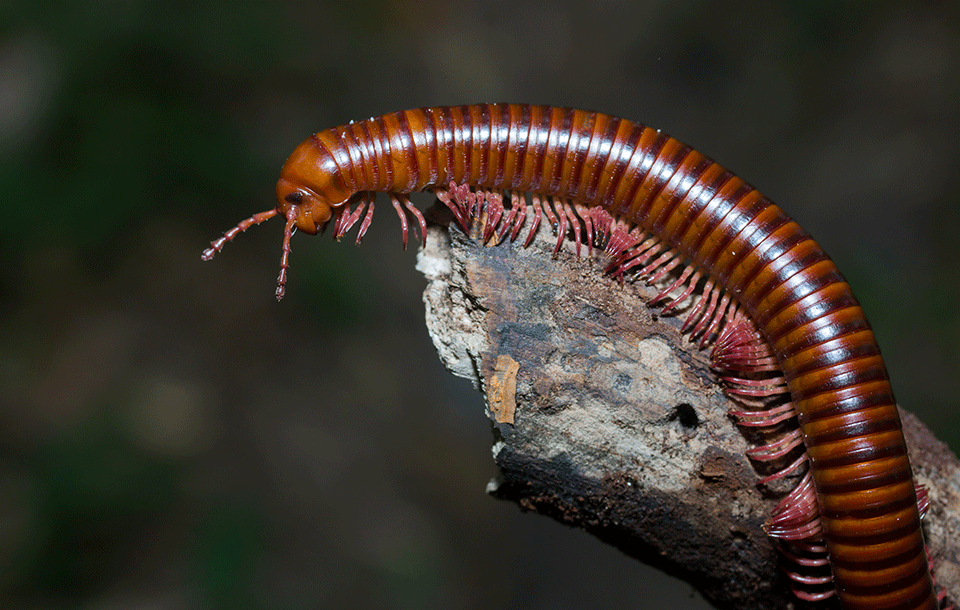
WHAT SENDS MILLIPEDES INDOORS
After heavy rain: Saturated ground drives them out all at once. That’s why millipedes arrive in numbers rather than one at a time, often within a day of a hard storm.
During a dry stretch: The opposite works too. When the soil dries out, millipedes go looking for somewhere cooler and damper, and a basement or garage is the closest thing they can find.
When it turns cold: Fall migrations are the big ones. As temperatures drop, millipedes move toward foundations looking for somewhere to overwinter, and any gap at ground level will do.
HOW IT WORKS

INSPECT
Your technician starts with a conversation, then walks your property to find activity, entry points, and risks worth watching.

PROTECT
Webs and nests come down, the foundation and key areas get treated, entry points are addressed, and the interior is treated as needed.

PROVE
Before leaving, your technician recaps the visit. Afterward, you get a video of the service, backed by our Worry-Free Guarantee.
FREQUENTLY ASKED QUESTIONS
No. Millipedes have no biting mouthparts capable of breaking skin, no stinger, and no venom. Their only defense is curling into a spiral and releasing a foul-smelling fluid, which can irritate sensitive skin and stain light-colored surfaces if one gets crushed. Wash your hands after handling one, and that’s the end of it.
Because they move as a group. Millipedes live in the soil in numbers you’d never notice until weather pushes the whole population at once, usually after a heavy rain, during a hot dry stretch, or in fall. They don’t trickle in. They arrive.
Sweep or vacuum the ones indoors, then deal with the yard, because that’s where the problem actually is. Pull mulch back from the foundation, clear leaf litter and grass clippings, fix drainage so water runs away from the house, and keep gutters and downspouts moving. Sealing gaps at doors and the foundation closes the rest.
Not usually. Millipedes come in from outside rather than breeding indoors, so what they’re telling you about is the ground around your house, not the air inside it. Overwatered beds, thick mulch against the foundation, and poor drainage are the usual culprits.
No. Millipedes don’t chew wood, ruin fabric, get into food, or breed indoors. They eat decaying plant material and nothing else, which means the only real problem is how many of them turn up and the mess when they do.
Count the legs per segment if you can get close enough. Millipedes have two pairs per segment, a rounded body, and move slowly. Centipedes have one pair per segment, a flatter body, and move fast. The fast ones can bite. The slow ones can’t. If it’s the other kind, visit Centipede Control.
GET STARTED TODAY!
GET A FREE QUOTE
The yard is theirs. The house isn’t. Tell us a little about your property, and we’ll send a free, no-obligation quote. No hidden fees, no confusing contracts, just a clear price for your home. Fill out the form, and we’ll take it from there.